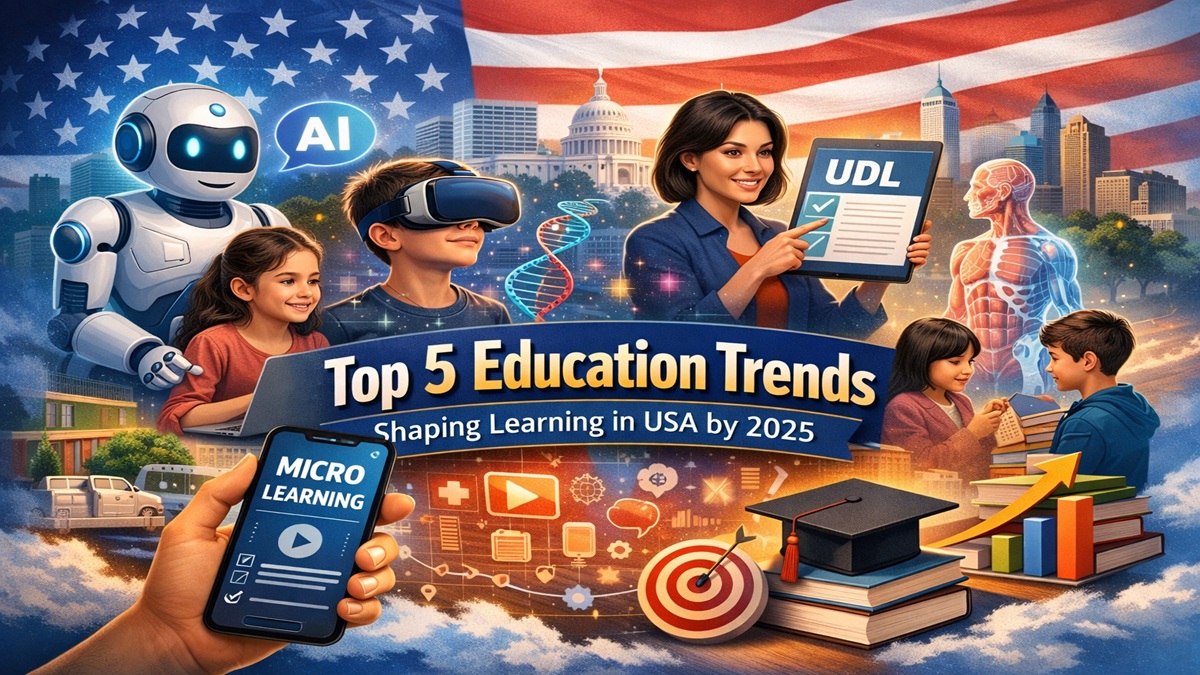
The US education landscape is rapidly evolving with new technologies and teaching approaches. Tools like AI-driven tutors, virtual reality (VR) lessons, and flexible learning methods are transforming how students learn. For example, searches for “AI in education” surged roughly 20-fold in the past five years, as AI tutors and automated lesson planners become more common. Educators are also focusing on inclusive practices and bite-sized learning to meet diverse needs. In 2026 and beyond, key trends include expanded assistive technology, immersive learning environments, Universal Design for Learning (UDL), microlearning, and outcomes-based education. These approaches promise to make US classrooms more engaging, accessible and effective.
1. Assistive Technology Expands in Classrooms
Classrooms are increasingly using assistive technologies originally designed for special education to help all students learn. In 2026, advances powered by AI and sensors will make these tools more widespread. For example, AI-driven speech-to-text software can transcribe lectures in real time, helping students with hearing impairments or learning disabilities follow along. Wearable haptic devices (like VR gloves or smartwatches) can vibrate to give directional cues, benefiting visually impaired or neurodiverse students. Eye-tracking systems let students control computers with their gaze, giving non-verbal or motor-disabled learners a way to communicate and participate. Even smart digital pens that record audio while writing allow students with attention challenges to review lessons later. These innovations give all students more autonomy and ensure learning materials are accessible to everyone.
- AI Speech Recognition: Converts spoken words to text in real-time, aiding hearing-impaired or language-challenged students.
- Haptic Wearables: Devices (like vibrating gloves or bracelets) guide students who need sensory prompts or alerts.
- Eye-Tracking Interfaces: Let students select and communicate by looking at words on a screen, enabling participation for those with mobility or speech impairments.
These tools help remove barriers. As one source notes, assistive tech is moving beyond special education and becoming “more accessible in mainstream classrooms”.
2. Immersive VR/AR Learning Labs
With declining K–12 enrollment in some US districts, many schools are repurposing empty classrooms into immersive learning labs. These tech-rich spaces use virtual or augmented reality to simulate real-world scenarios. For instance, virtual field trips let students “visit” historical sites or science museums via VR headsets, making content more engaging and memorable. Career simulation labs use AR/VR so students can practice skills (like exploring a 3D human body in a health class) before internships. Mixed-reality projects let learners manipulate 3D models anchored in the room – for example, constructing a digital model of a house to explore architecture concepts.
These environments give students hands-on experiences that traditional lectures cannot. Educators report that technology exposure also builds familiarity with future workplace tools. One study even notes that US public school enrollment dropped from about 50.8 million in 2019 to 49.4 million during the pandemic – meaning many classrooms were underused. Immersive tech helps districts use these spaces innovatively while preparing students for high-tech careers.
3. Universal Design for Learning (UDL)
Universal Design for Learning (UDL) is a framework that creates lessons with all students in mind from the start. Instead of retrofitting materials for disabilities, UDL builds flexibility so every student can access content. The approach has three main principles:
- Multiple means of representation: Present information in various formats (text, audio, video, visuals) so learners can grasp ideas in the way that works best for them.
- Multiple means of action and expression: Allow students to show knowledge in different ways, such as speaking, writing, or creating media.
- Multiple means of engagement: Offer choices in activities and topics to tap into each student’s interests and motivation.
Originally from special education, UDL is becoming mainstream in US schools. Researchers emphasize that proactively designing lessons for diverse learners improves understanding for everyone. In practice, UDL means teachers might provide a video version of a lecture and an interactive graphic, letting each student choose what helps them learn best. As one expert notes, education is moving toward “more personalized, inclusive learning environments” where every student can thrive.
4. Microlearning & Bite-Sized Lessons
Traditional classes often overwhelm students with long lectures. In contrast, microlearning breaks content into short, focused units or videos. This trend is growing in K–12 and adult education alike. By teaching one concept at a time and repeating it later, microlearning helps students digest information gradually. For example, a math unit might be split into daily 5-minute videos on each subtopic, rather than a single 50-minute lecture. Studies suggest that short, spaced bursts of learning can significantly boost retention. In other words, students remember more when lessons are concise and revisited.
In practice, teachers might use 5–10 minute interactive quizzes, animated explainer clips, or quick practice drills as micro-lessons. This approach keeps students engaged and prevents overload. Microlearning also fits busy lifestyles: high schoolers and adult learners with after-school jobs can squeeze in quick review sessions. As ACE’s education blog explains, breaking lessons into modules lets students “master specific skills without becoming overwhelmed by large quantities of information”. In the US, schools are increasingly adopting micro-courses and competency-based modules to target skill-building and personalized pacing.
5. Outcomes-Based Education & Contracting
Schools are shifting from just buying textbooks or tools to outcomes-based approaches. This means curriculum, teaching, and even vendor contracts are tied to measurable student results. For example, a district might pay a tutoring company only if students achieve a certain test score improvement. The goal is to focus resources on what actually boosts learning. By 2025, more US schools are expected to demand evidence of effectiveness (such as higher graduation rates) when choosing programs. This trend adds accountability and transparency: taxpayers and school boards see that funds are spent on proven methods.
However, outcomes-based strategies also pose challenges. Schools must carefully define fair metrics so all student groups benefit. Done well, this shift could encourage innovation: educators and companies will develop new tools aimed directly at improving learning outcomes. Overall, tying education spending to results helps ensure every decision supports student success.
Conclusion: By 2026, American classrooms will likely look very different. Adaptive tools will assist diverse learners, VR/AR will bring subjects to life, and lessons will be more personalized and data-driven. Educators and policymakers should embrace these trends to help all US students learn more effectively. With thoughtful implementation, the future of education promises greater engagement, inclusion, and achievement.
Also visit :- aspects behind the mega tsunami warning
1 thought on “Top 5 Education Trends Shaping Learning in USA by 2026”