The Indian stock market has been on a wild ride lately. After facing steep declines earlier in March 2026, the benchmark indices—Nifty 50 and BSE Sensex—have shown a mix of sharp drops and mild recoveries. With investors feeling cautious, everyone is asking the same questions: What happens next? Here at Mineverse360.com, we have analyzed the latest market data, global cues, and institutional trading patterns to provide a clear, research-based forecast for the coming days, weeks, and months.
How Will the Indian Stock Market Perform Tomorrow? (March 23, 2026)
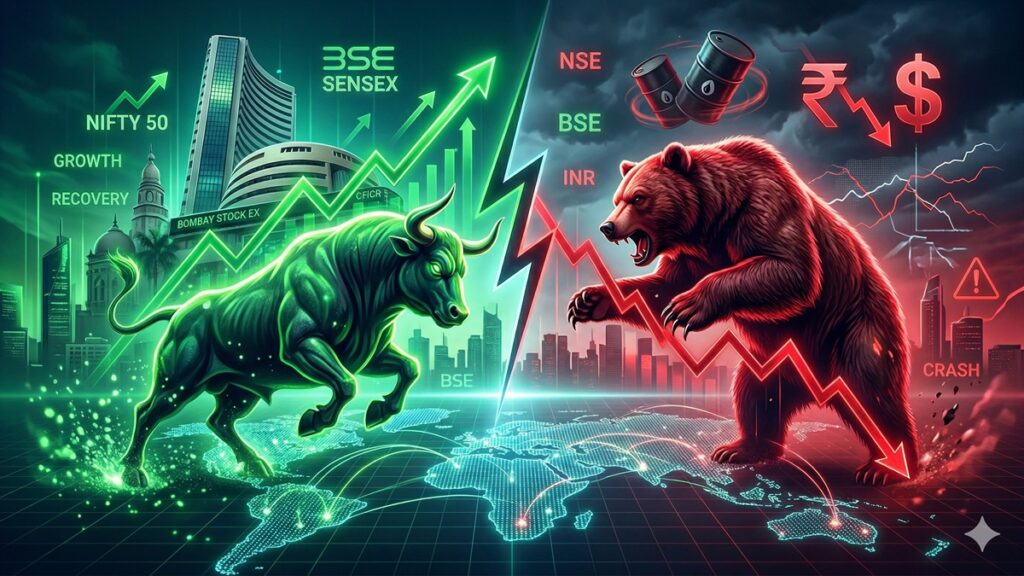
Tomorrow’s trading session is expected to open with a cautious and potentially volatile tone. On Friday (March 20), the Nifty 50 closed slightly higher at 23,114, while the Sensex settled at 74,532. However, this mild recovery lacks strong momentum.
- Key Levels to Watch: For Nifty, the immediate psychological support is at 23,000. If the market breaks below this level, we could see panic selling pushing the index toward 22,850.
- Resistance: On the upside, 23,300 to 23,500 will act as a strong wall. The market is unlikely to cross this easily unless there is highly positive global news.
- Verdict: Expect a sideways-to-negative market tomorrow. Traders should avoid aggressive long positions and watch how the market behaves around the 23,000 mark.
Weekly Outlook: What to Expect This Week? (March 23 – March 27)
This week is going to test the patience of investors in the Indian stock market. The broader structure remains under pressure due to global uncertainties.
- Volatility is the Theme: The India VIX (volatility index) has been spiking, meaning sharp swings in both directions are highly likely.
- Trading Holiday: Keep in mind that the Indian stock exchanges (NSE and BSE) will be closed on Thursday, March 26, 2026, for a public holiday. This shortened trading week often leads to aggressive position-squaring by options traders on Wednesday.
- Verdict: The week will likely be dominated by “sell-on-rise” behavior. Unless the Nifty gives a closing above 23,500, the bears (sellers) will remain in control.
Monthly Forecast: How Will the Market Perform This Month?
For the remainder of March and heading into April 2026, the Indian stock market is stuck in a consolidation phase. The days of easy, straight-line upward rallies are on pause for now.
While Domestic Institutional Investors (DIIs) are doing an excellent job of supporting the market through heavy SIP inflows from retail investors, the Foreign Institutional Investors (FIIs) are aggressively pulling money out. Until this FII selling stops, the market will struggle to hit new all-time highs. For the month, expect a range-bound market where stock-specific action (like IT and select Pharma) might yield better results than investing in the broader index.
Major Factors That Can Crash the Indian Stock Market
Even though India’s long-term economic growth story remains strong, several short-term factors can trigger a market crash or a deep correction right now:
- Geopolitical Tensions (Middle East): The escalating conflicts in the Middle East, particularly tensions involving the US and Iran, are the biggest threat. Wars disrupt global supply chains and make investors pull their money out of risky assets like stocks.
- Surging Crude Oil Prices: India imports more than 80% of its oil. With Brent crude prices spiking (often crossing $110+ per barrel during global tensions), it directly increases inflation in India and hurts the profit margins of Indian companies.
- Relentless FII Selling: Foreign investors have pulled tens of thousands of crores out of Indian equities in recent weeks. If they continue to sell at this pace, domestic buying alone won’t be enough to hold the market up.
- Record-Low Rupee: The Indian Rupee has recently hit record lows against the US Dollar (crossing the 93.70 mark). A weak rupee makes foreign investments less attractive and increases the cost of imports, putting pressure on the economy.
- Rising Inflation & Interest Rates: If oil prices keep inflation high, the Reserve Bank of India (RBI) cannot cut interest rates. High interest rates are generally bad for stock market growth because they make borrowing expensive for companies.
The Indian stock market is currently in a “wait and watch” mode. For long-term investors, market dips toward the 22,500 level might offer a great opportunity to buy quality stocks at a discount. However, short-term traders should use strict stop-losses and avoid taking heavy risks.
Disclaimer: This article is based on market research and technical analysis. Stock market investments are subject to market risks. Please consult your financial advisor before making any investment decisions.
Visit:- mineverse360.com