In a stunning move that has sent shockwaves through the football world, Real Madrid announced on Monday that they have parted ways with head coach Xabi Alonso. The decision came just one day after Real’s 3-2 loss to Barcelona in the Spanish Super Cup final. The club confirmed the change in a statement, noting it was made by mutual agreement. Shortly afterward, Real revealed that Álvaro Arbeloa, a former Real defender and current youth coach, will take over as first-team manager.
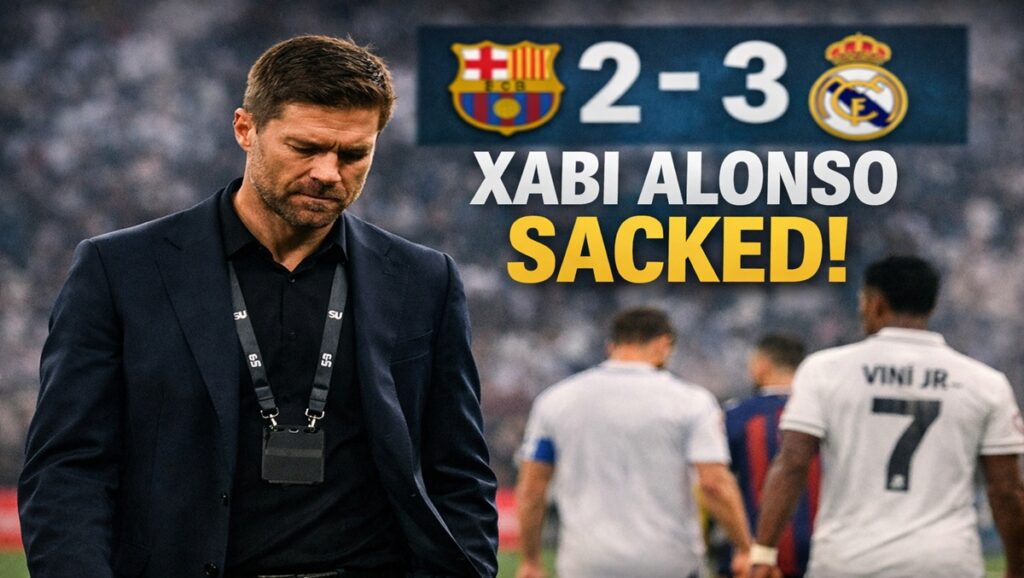
Real Madrid’s official statement praised Alonso as a “legend” of the club and thanked him for his work, saying the club will always be his home. But despite these warm words, the abrupt sacking underscores how high Real’s expectations are. Alonso – a 44-year-old former midfield star – had taken charge of the team only seven months ago, in June 2025, replacing the long-serving Carlo Ancelotti (who left to manage Brazil’s national team). His departure marks one of the quickest managerial exits in Real’s recent history, and it comes at a time when the club is second in La Liga but craving trophies.
Key Facts at a Glance:
- Manager: Xabi Alonso (age 44), appointed June 2025.
- Tenure: ~7 months in charge of Real Madrid’s first team.
- Record: About 28 matches, roughly 20 wins and 5 losses (plus a few draws).
- Trigger: 3-2 loss to Barcelona in the Spanish Super Cup final (Jan 2026).
- Replacement: Álvaro Arbeloa, former Real defender and coach in the club’s academy.
Alonso’s Journey to Real Madrid
Xabi Alonso is no stranger to the Bernabéu. The Spanish midfield legend played for Real from 2009 to 2014, helping the club win multiple Champions League and La Liga titles. After retiring, he built an impressive coaching resume. Most notably, Alonso took over at Bayer Leverkusen in Germany in late 2022 and quickly turned the team into champions. In the 2023–24 season, Leverkusen went undefeated in the Bundesliga and won the title for the first time in their history. They also secured the German Cup that year. Such success made Alonso one of the most highly rated coaches in Europe.
Thanks to his achievements with Leverkusen, Alonso was seen as a prime candidate for big jobs. He was reportedly on the shortlist to replace Jurgen Klopp at Liverpool and even drew interest from Bayern Munich. However, when Real Madrid came calling for the 2025–26 season, Alonso accepted the challenge. He arrived at the start of the campaign amidst great optimism. The club had a star-studded squad – featuring players like Kylian Mbappé, Jude Bellingham, and Vinícius Jr. – and fans expected Alonso to guide them to domestic and European glory.
Struggles and Setbacks
Yet the transition was not smooth. While Alonso had proven himself in Germany, Spain presented a different challenge. Over the autumn of 2025, Real’s form was inconsistent. Injuries to key players, including Mbappé at times, hampered the team. A poor run in November saw Real fail to win three straight matches, drawing with mid-table teams and losing a Champions League game. During that spell, some reports suggested whispers of tension in the dressing room.
In late November, Alonso publicly insisted the squad was “united” despite any rumors. Star players rallied to his defense – after a win in the Champions League, forward Kylian Mbappé stated the team needed to “protect” Alonso, and winger Vinícius Jr. was seen embracing the coach on the pitch. These signs seemed to show the players supported the coach during a difficult period.
Indeed, just a few weeks before the final, Real had won a crucial Super Cup semifinal against Atlético Madrid, beating their city rivals to reach the showpiece match. That victory had calmed the storm of criticism and was seen as a lifeline for Alonso’s position. Many observers believed that if Alonso lifted the Super Cup trophy, his job would be safe for now.
The Final Straw: Spanish Super Cup
The Super Cup final took place on Sunday (Jan 11, 2026) in Saudi Arabia, where Real Madrid faced fierce rivals Barcelona. It was a thrilling contest, but ultimately a 3-2 defeat for Real at the hands of Barcelona. In the wake of that loss, Real’s president Florentino Pérez and the club’s decision-makers acted swiftly. Less than 24 hours later, Real announced Alonso’s exit.
The official club statement read: “Real Madrid C.F. announces that, by mutual agreement between the club and Xabi Alonso, it has been decided to end his time as first team coach.” The statement emphasized mutual respect, calling Alonso a “legend” who “has always represented the values of our club” and saying Real Madrid will always be his home. The club also thanked Alonso and his staff for their work and wished them luck in the future.
Although the statement was diplomatic, the timing made it clear that the Super Cup defeat was the final straw. Media reports suggest the board had given Alonso a last chance by winning the semifinal. Losing in the final to Barcelona – especially in such a dramatic game – forced their hand. On one hand, Real Madrid are a trophy-focused club; going six months without silverware may have been unacceptable. On the other hand, Real sit second in La Liga (four points behind Barcelona) and are on course to advance in the Champions League. Still, Real officials must have felt that a change was needed immediately.
Why Was Alonso Sacked?
Analysts point to a combination of factors behind Alonso’s sacking. The official line of “mutual agreement” is a polite way of saying he was effectively dismissed. The decision comes after a rough patch of form, but also amid reports of deeper issues. Sources close to the club had mentioned that injuries and uneven results made life difficult for the young coach. There were also whispers of “dressing room unrest” – though Real’s star players had publicly denied any serious rift just weeks earlier.
It’s possible that Alonso’s lack of experience as a top-level manager played a role. Despite his success in Germany, managing the Real Madrid first team is on a different level of pressure. Working with big egos and delivering instant success at the Bernabéu is notoriously challenging. Some pundits speculate that Alonso struggled to assert his authority over veteran players or to fully impose his tactics in such a short time.
Another factor could be the club’s ambitious schedule. Real Madrid have set their sights on the Champions League title and would not want to risk falling behind by sticking with a coach who was not maximizing the team’s potential. In high-pressure clubs like Real, patience is often thin.
Whatever the exact mix of reasons, the end result was clear. After roughly 28 games in charge, with about 20 wins and 5 losses, Xabi Alonso was out as Real Madrid manager. His time in charge was far shorter than anyone expected when the season began.
Álvaro Arbeloa Takes Charge
Almost immediately after Alonso’s departure, Real Madrid announced that 41-year-old Álvaro Arbeloa would be the new first-team coach. Arbeloa is another former Real Madrid star – a reliable defender who played over 200 games for the club between 2009 and 2016, winning multiple titles including the Champions League.
However, Arbeloa has never managed at the senior level. After retiring from playing in 2017, he joined Real’s youth coaching setup. He had success with the academy teams – notably leading the under-19 squad to a treble (league, Copa del Rey, and Champions Cup) in 2023, and winning the youth league in 2025. Just last summer, Arbeloa was promoted to manage Real Madrid Castilla (the reserve team). Reports say he did a “solid job” with the reserves, impressing the club’s hierarchy.
In naming Arbeloa, Real opted for an inside man who knows the club’s culture. In the short term, he will take charge of the senior squad while the club considers its long-term options. Arbeloa’s first match in charge will be in the Spanish Cup (Copa del Rey) against Albacete this week. There is no indication yet whether he will remain in the role beyond this season or if he is simply a caretaker.
Real Madrid’s quick choice of Arbeloa suggests the club wanted continuity and stability. It also signals trust in the club’s youth system. Arbeloa is seen as someone who can steady the ship and maybe bring out the best in the existing squad in the short term. Given time, his deep understanding of Real Madrid’s philosophy might pay dividends.
Reaction and What’s Next for Alonso
Fans and media reactions to Alonso’s sacking have been a mix of surprise and concern. Many Real supporters respected Alonso’s return to the club; he had played such a key part in Real’s history as a player. His departure feels sudden, even if some had sensed his job was under threat. Former players and pundits have noted that Alonso may have an even brighter managerial future ahead, given his pedigree and success in Germany.
Indeed, while his Real stint ended abruptly, Alonso’s career is far from over. There is speculation about his next move. Some suggest he could return to coaching in a less pressured environment, or perhaps take time off before taking another top job. Others think he might even get a call from national teams or clubs that value his modern coaching style. If Liverpool or Bayern still have faith in him, he could land another high-profile role. But he will surely want some time to regroup after such a whirlwind experience at Madrid.
For Real Madrid, the focus shifts back to the season. The immediate task is to keep winning La Liga and progress in Europe under Arbeloa’s guidance. The club’s leadership will also be thinking about who could be the long-term successor to Alonso. Big names will no doubt be discussed – but Real have shown that if needed, they can turn to their own ranks for solutions.
The headline decision is made: Xabi Alonso is out as coach, Álvaro Arbeloa is in. What remains uncertain is how this shake-up will affect Real’s season and Alonso’s career going forward. One thing is clear: in the high-stakes environment of top-flight football, fortunes can change very quickly.
Visit more articles:- https://mineverse360.com/aspects-behind-the-mega-tsunami-warning/